Custom AI agent · Operations
AI Equipment Downtime Monitoring Agent
See downtime developing before it becomes a larger operational problem.
Monitor approved equipment signals, organize downtime events, and prepare maintenance context with human-verified explanations and handoffs.
- Turn approved machine, sensor, maintenance, and production signals into a reviewable downtime picture.
- Help teams distinguish active stops, planned maintenance, recurring patterns, and uncertain signals.
- Route the right evidence to maintenance and operations owners without claiming a fault that has not been verified.
Starting at $300 USD/month
Starting price is $300 USD/month for a tailored solution. Your final proposal defines the scope, integrations, usage, hosting, and support terms before work begins.
What is an AI equipment downtime monitoring agent?
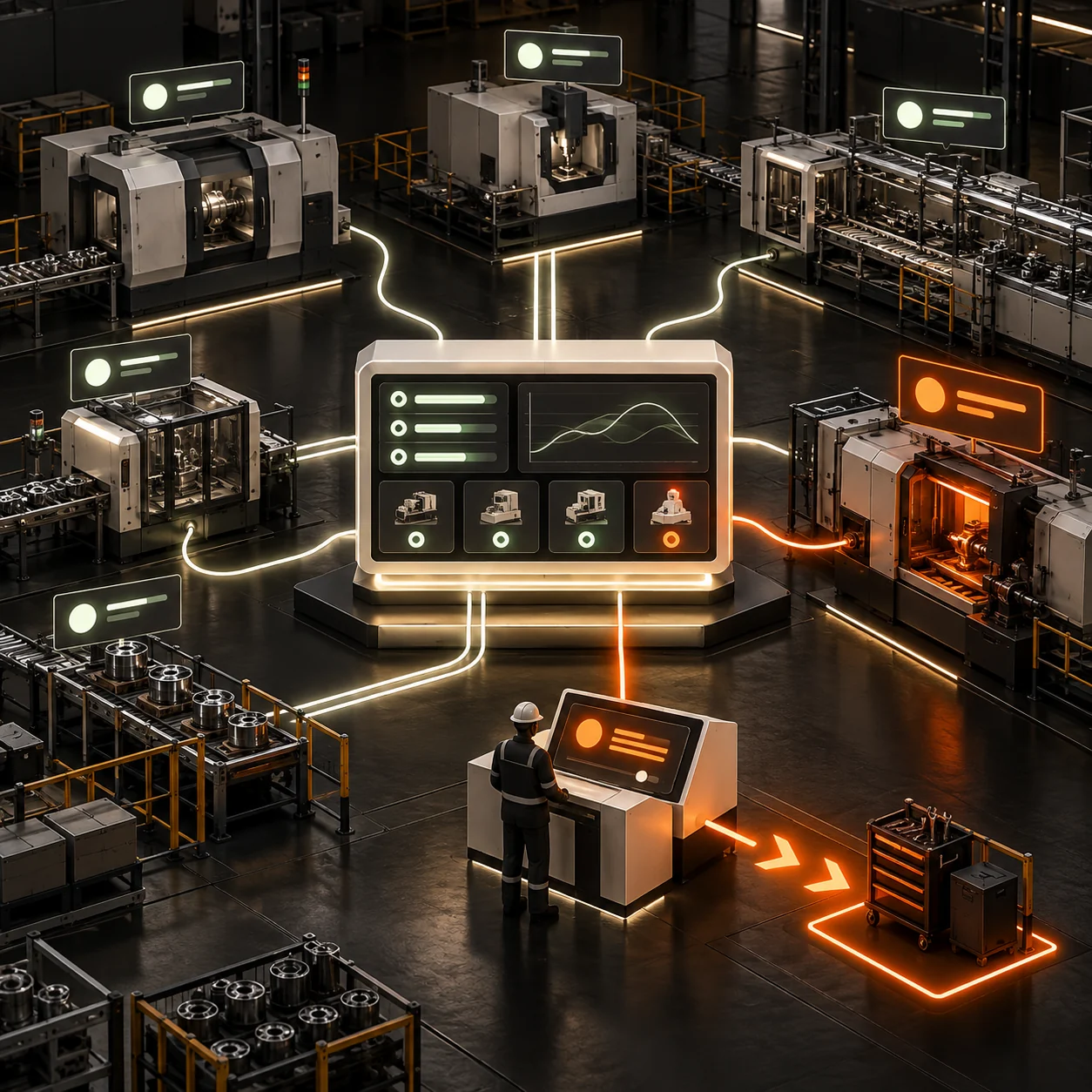
The AI equipment downtime monitoring agent helps operations and maintenance teams organize signals about machine availability and production interruptions. It correlates approved telemetry, machine states, work orders, operator notes, schedules, and production context into an explainable view of downtime events. It can surface patterns and prepare response queues, but qualified operators and maintenance owners confirm the cause, safety status, repair, and return to service.
Turn machine signals into maintenance-ready context
Downtime event detection
Identify and group approved state changes, stoppages, slow cycles, planned windows, and signal gaps with timestamps and equipment context.
Cause and confidence mapping
Separate observed machine state from possible causes, maintenance notes, operator context, and unresolved hypotheses so teams can investigate safely.
Impact and recurrence analysis
Connect duration, production schedule, line dependencies, throughput context, and recurring patterns using the definitions your team approves.
Maintenance handoff queues
Prepare prioritized work items with evidence, affected equipment, safety notes, owner, escalation path, and verification criteria.
Where it can help
Production line monitoring
Give supervisors a shared view of active and recurring interruptions across lines, cells, and critical equipment.
Preventive maintenance review
Use approved downtime history and work-order context to identify assets that deserve a maintenance or inspection review.
Shift handoff operations
Summarize unresolved stops, temporary fixes, parts needs, and verification steps for the next authorized team.
How it works
A step-by-step workflow your team can review before launch.
1. Define
Set equipment hierarchy, states, planned windows, signal sources, owners, safety rules, and downtime definitions.
2. Observe
Collect approved telemetry, state changes, schedules, work orders, operator notes, and production context with timestamps.
3. Explain
Group events, estimate impact, separate facts from hypotheses, and flag gaps or conflicting signals for investigation.
4. Act
Maintenance and operations owners approve the response, record cause and repair evidence, and verify return to service.
Built around your business
What we configure
- Equipment hierarchy, machine states, planned downtime, production schedules, lines, cells, and criticality
- PLC, SCADA, MES, historian, IoT, CMMS, work-order, operator, and shift-handoff sources
- Detection windows, recurrence rules, severity, confidence, escalation, safety, and acknowledgement policies
- Maintenance queues, notifications, dashboards, exports, audit fields, and return-to-service checks
What we need from you
- Authorized telemetry, machine-state, maintenance, schedule, and operator data
- A documented equipment hierarchy and definitions for running, stopped, planned, faulted, and unknown states
- Named maintenance, operations, safety, and data-quality owners
- An approved process for investigation, lockout/tagout, repair, and return-to-service verification
Clear boundaries before launch
What it will not do
The agent does not diagnose equipment with certainty, override safety controls, issue maintenance commands, infer a safe state, or authorize a repair or restart. It does not replace qualified technicians or predictive-maintenance validation, and it must not treat missing telemetry as normal operation. Human owners verify causes, safety, repairs, and production decisions.
How success is measured
Measure event-detection latency, downtime coverage, false alerts, unknown-state duration, mean time to acknowledge, mean time to repair, recurrence rate, work-order completeness, return-to-service verification, and operational outcomes defined by your team.
Frequently asked questions
What equipment signals can it monitor?
It can organize approved machine states, telemetry, alarms, work orders, schedules, operator notes, and production context when sources, permissions, and meanings are documented.
Can it diagnose a machine failure?
It can surface observed patterns and possible explanations, but qualified technicians must confirm the cause, safety status, repair, and return to service.
Can it stop or restart equipment?
No. It should not issue control commands or bypass safety systems; authorized operators and maintenance teams retain control.
How does it distinguish planned downtime?
Planned windows, schedules, maintenance events, and state definitions can be configured so planned activity is separated from unexpected interruption for review.
Can it work with existing industrial systems?
It can use approved exports or integrations from systems such as MES, SCADA, historian, IoT, CMMS, and work-order platforms when access and data mappings are defined.
What does the $300/month starting price include?
It is a starting price for a tailored solution. Final scope, integrations, usage, hosting, support, and deliverables are defined in your proposal.